

Hello and Welcome,
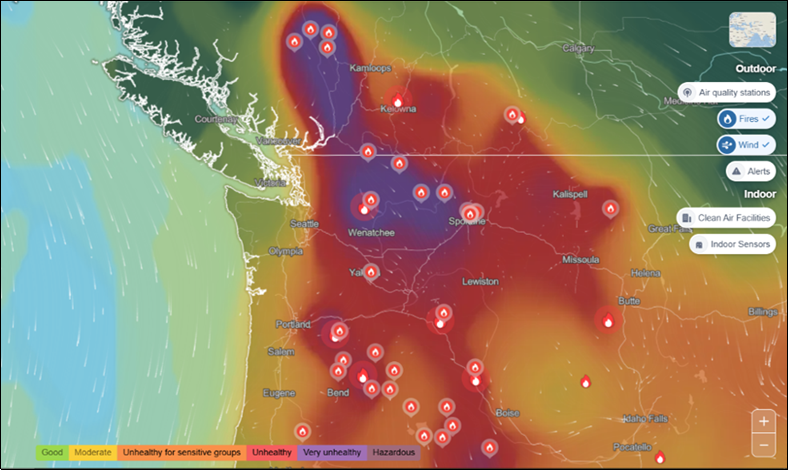
As many of you may be aware, northwest North America is burning. Some people are certainly more impacted than others. However, the extensive loss from this devastating event will be felt by a very many for a very long time.
Some things can be replaced or rebuilt and made familiar with memories. The loss of a loved one, family member or close friend creates a burden of nothingness that carries the weight of the world.
It is our hope that people in positions to effect change are doing so with godspeed. The strategies they employ to end this devastation will be carried out by a limited few. They are the ones who run to the danger, not from it.
What We Know, and Don’t Know
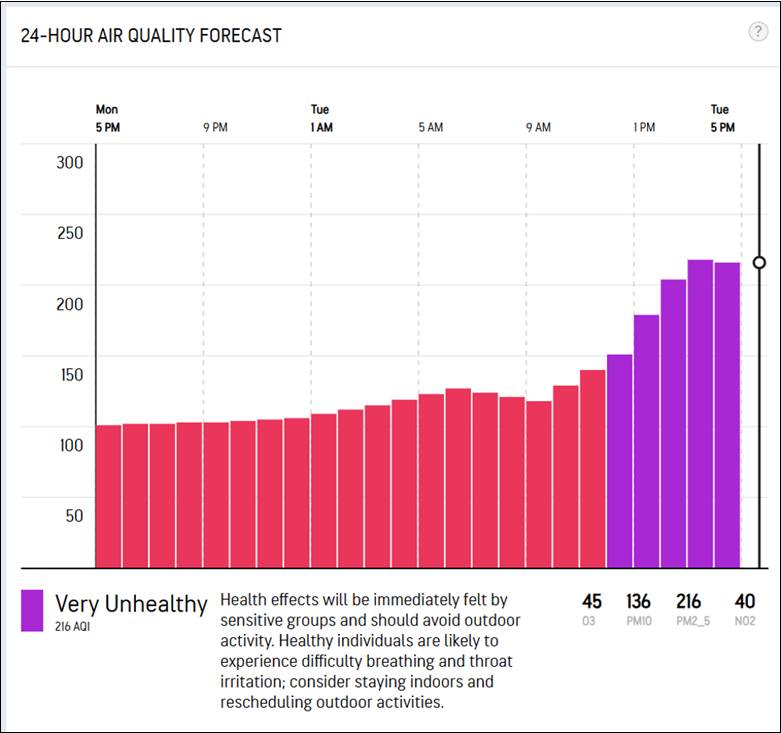
As winegrowers, we are not directly involved in the fires. They have not come into the Willamette Valley (yet), however the smoke is here in Dallas, where we are located. It is the beginning of August and our Pinot Noir is beginning to turn color. As the fruit begins to ripen, it will certainly become more susceptible to smoke taint.
It remains to be seen if this event, or more like it yet to come, will impact wine quality. We don’t know, but we know how to know thanks to Vintage 2020. Perhaps the knowledge we gained from that ill-fated vintage can be helpful.
Here is what we do know regarding a phenomenon that can be directly responsible for extending the range of these fires. This phenomenon is called a Pyrocumulonimbus (pyroCb) cloud—often called the “fire-breathing dragon of clouds” by NASA.
This cloud formation can be the reason these fires will continue to rage and expand in size. PyroCb clouds can create their own lightning, (often miles ahead of the main fire), thus self-perpetuating and expanding their range. Here are the mechanics of how these clouds form and the resulting effects they can cause. Source: https://www.bom.gov.au/
Pyrocumulonimbus (pyroCb) Cloud
A pyroCb cloud is an extreme, fire-generated thunderstorm that forms over intense heat sources like massive wildfires, volcanic eruptions, or detonations. Instead of being driven by typical atmospheric moisture, these towering systems are powered by the superheated air, ash, and smoke produced by the disaster below. They allow an intense fire to essentially create its own weather, establishing a dangerous feedback loop that accelerates the disaster.
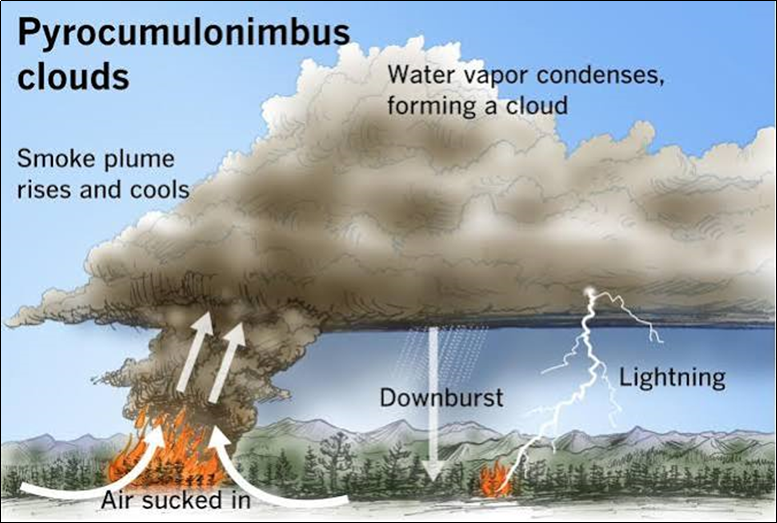
Here is how this phenomenon develops. The development of a pyroCb relies on an unstable atmosphere combined with an incredibly intense surface heat source.
The Thermal Chimney: A massive wildfire generates intense, superheated plumes of air and smoke that rise rapidly into the atmosphere like a giant chimney, sucking in oxygen at ground level to further feed the fire.
Moisture Condensation: As this smoke column climbs miles into the cooler, lower-pressure atmosphere, the air expands and cools. Water vapor (both from the atmosphere and released by burning vegetation) condenses around the rising particles of ash, forming a gray or brown “pyrocumulus” cloud.
The Thunderhead Transition: If the atmosphere is highly unstable—typically with scorching, dry air near the ground and cold, moist conditions aloft—the updraft continues climbing up to 6 to 9 miles (10–15 km) high, even punching into the stratosphere. Above the freezing level, the water droplets turn into ice crystals. Their violent collisions separate electrical charges, officially turning the fire cloud into an electrified, fully operational thunderstorm.
And here is what they can do. Pyrocumulonimbus clouds are highly dangerous and create unpredictable, catastrophic conditions for ground crews.
Dry Lightning: While these clouds act like normal thunderstorms, the lower atmosphere beneath them remains intensely hot and dry. Any rain generated often evaporates before hitting the ground (a phenomenon known as virga). However, the lightning strikes still hit the parched ground, triggering entirely new “spot fires” miles ahead of the main fire front.
Erratic, Violent Winds: The intense updraft pulls air rapidly toward the core of the fire, while falling cold air generates sudden, violent downbursts (downdrafts) that strike the surface. This drives the flames in entirely unpredictable, shifting directions.
Fire Tornadoes: In extreme scenarios, the interaction between the massive convective column and ambient wind shear can spin up devastating, flame-filled vortices, known as fire tornadoes.
Stratospheric Pollution: Because pyroCbs function like a volcanic eruption, they shoot massive amounts of smoke, ash, and black carbon directly into the stratosphere. This particulate matter can remain trapped in the upper atmosphere for months, traveling thousands of miles and impacting global climate patterns.

Kindest Regards,
Dena & Ernie
Other Resources
Visit our Website
Visit the FLOG Archive
Take the Amalie Robert Tour
Shop Amalie Robert Direct
Download your FREE Willamette Valley sub-AVA Guide
Alaska Airlines Wines Fly Free